
Delegating AI Assessment? Why SME Leaders Must Stay Involved
In the age of rapidly advancing artificial intelligence (AI), small and medium enterprise (SME) leaders are under increasing pressure to explore how automation and machine learning can reduce costs, improve efficiency, and ensure competitiveness. But while many forward-thinking business owners are eager to leverage AI’s potential, they often make a critical misstep: delegating the task of AI assessment and implementation entirely to their existing workforce.
This hands-off approach can be not only ineffective—it can be actively counterproductive. Why? Because AI, for all its promise, often represents a direct threat to employees’ roles, particularly those engaged in repeatable, rules-based tasks. Asking employees to objectively assess which of their own duties could be replaced by AI is like asking a soldier to identify which of their own battalion should be sent home—it’s not only emotionally fraught but fundamentally conflicted.
Resistance is Natural—and Historical
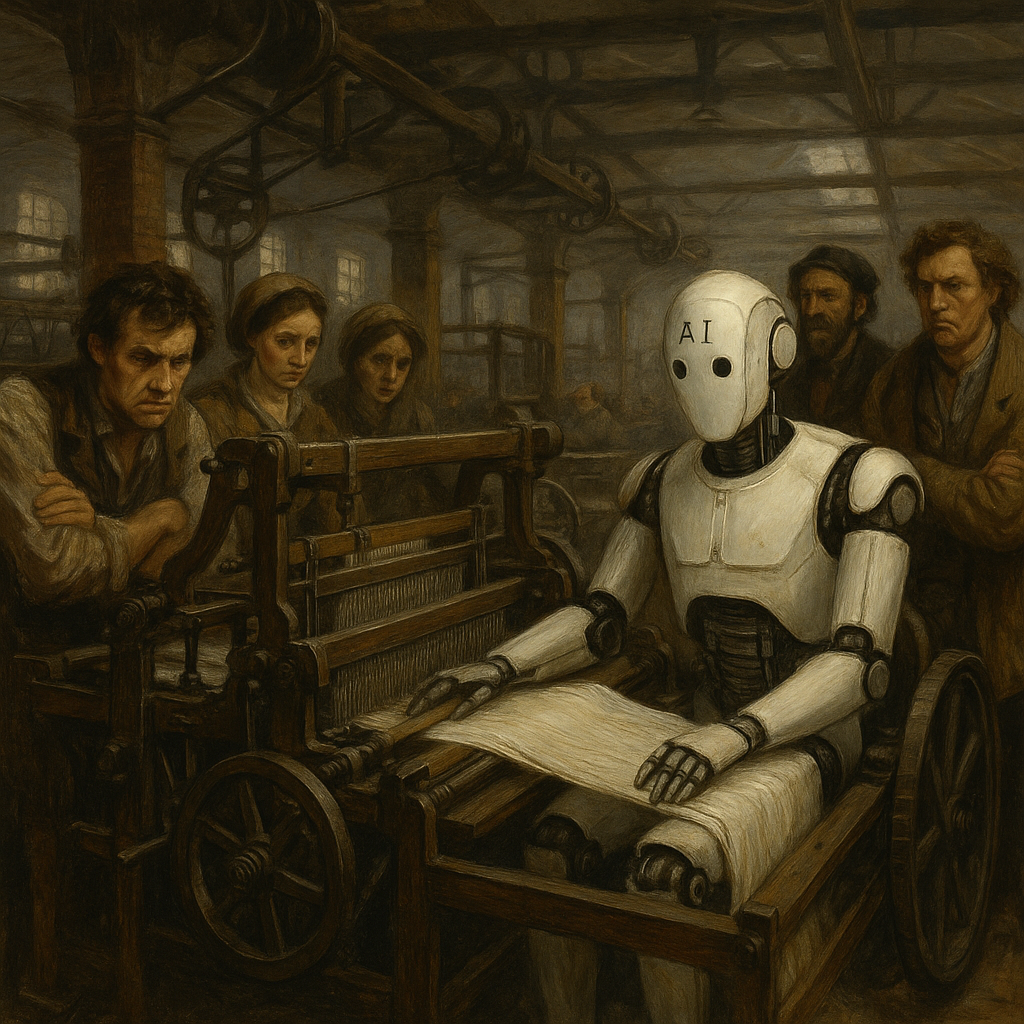
This phenomenon is not new. In fact, it echoes a much older story from the first Industrial Revolution. In 19th-century France and England, skilled textile workers saw their livelihoods threatened by mechanical looms. Rather than embrace the technology, many actively sabotaged it. The Luddites in England famously destroyed weaving machines; French canuts (silk weavers) rioted in protest of lower wages and mechanised production.
Their resistance wasn’t irrational. It was human. These workers were protecting their families, identities, and roles in society. In the same way, modern employees may subconsciously or deliberately resist AI tools that seem poised to make them redundant.
Today’s equivalent might not be smashing looms, but it can be just as disruptive—delaying projects, dismissing AI capabilities, providing biased assessments, or overcomplicating implementation processes to ensure failure.
The Modern Face of Subtle Sabotage
In SMEs where AI assessment is handed over entirely to staff—often middle managers or process owners—subtle forms of resistance may manifest:
- Minimising potential: AI pilots or assessments may be framed as “too limited” or “not ready for our industry.”
- Overcomplicating analysis: Employees might insist that tasks are too nuanced for AI to replicate, exaggerating the complexity to protect their domain.
- Delayed rollouts: Implementation timelines may mysteriously stretch out due to ‘integration’ or ‘training’ bottlenecks.
- Cherry-picking test cases: Employees may showcase AI on edge cases or high-failure-risk scenarios to create the impression of unreliability.
This form of “tech resistance” is rarely overt. In many cases, it’s driven by employees’ fears—of losing relevance, status, or even their jobs.
Why Leaders Must Stay Involved
SME leaders cannot afford to remain on the sidelines. Delegating AI exploration might seem logical—after all, staff understand the processes best—but when incentives misalign, assessments become suspect.
Leaders must actively participate in both assessing and implementing AI-based changes for three key reasons:
- Objectivity: Leadership has a broader strategic view and fewer emotional ties to specific roles or departments.
- Momentum: Executive presence in the process keeps timelines tight and energy high.
- Credibility: When leaders endorse AI as part of a long-term transformation, it frames the shift as inevitable and purposeful, rather than optional or experimental.
Detecting Resistance Early
Identifying when staff are (consciously or not) resisting AI adoption is crucial. Watch for the following red flags:
- Excessive analysis without conclusions
- Pilot programs with no clear KPIs or success benchmarks
- Feedback loops that only highlight problems, not solutions
- High turnover or disengagement in affected departments
- Mismatched priorities, where low-impact functions are automated while high-return opportunities are left untouched
Leaders should also solicit external opinions—consultants, AI vendors, or even cross-functional internal staff—to validate what is and isn’t realistically automatable.
Countering Resistance with Strategy and Empathy
Rather than bulldozing resistance, SME leaders can use a dual approach: strategic oversight with empathetic transition planning.
- Involve, but don’t relinquish: Let employees contribute insights but maintain leadership control over final AI recommendations.
- Create safe transitions: Offer upskilling, redeployment, or hybrid roles for staff whose jobs will be affected.
- Frame AI as augmentation: Emphasise how AI can enhance—not replace—human capability. For example, AI can eliminate tedious tasks, allowing workers to focus on higher-value work.
- Set clear metrics: Quantify success so results speak louder than opinions. ROI, time saved, error reduction—these are difficult to dispute.
- Communicate relentlessly: Make the AI transformation part of a broader strategic narrative—aligned with business growth, competitiveness, and innovation.
Conclusion: AI Is Too Strategic to Outsource
In summary, while employee input is invaluable, AI transformation is too strategically significant—and politically charged—to be outsourced entirely. Leaders must lead. That means being present in process mapping, technology evaluation, vendor selection, and post-rollout performance reviews.
By staying involved and attuned to the potential for internal resistance, SME leaders can ensure that AI fulfills its promise—not just of automation, but of evolution. And in doing so, they help their businesses—and their people—move confidently into the future, not defensively into the past.